What the oakmoss restriction actually says
The ceiling is 0.1 per cent of the finished bottle, not of the oil. In a chypre that is four tenths of a per cent of your concentrate. Here is how to build a base out of that.
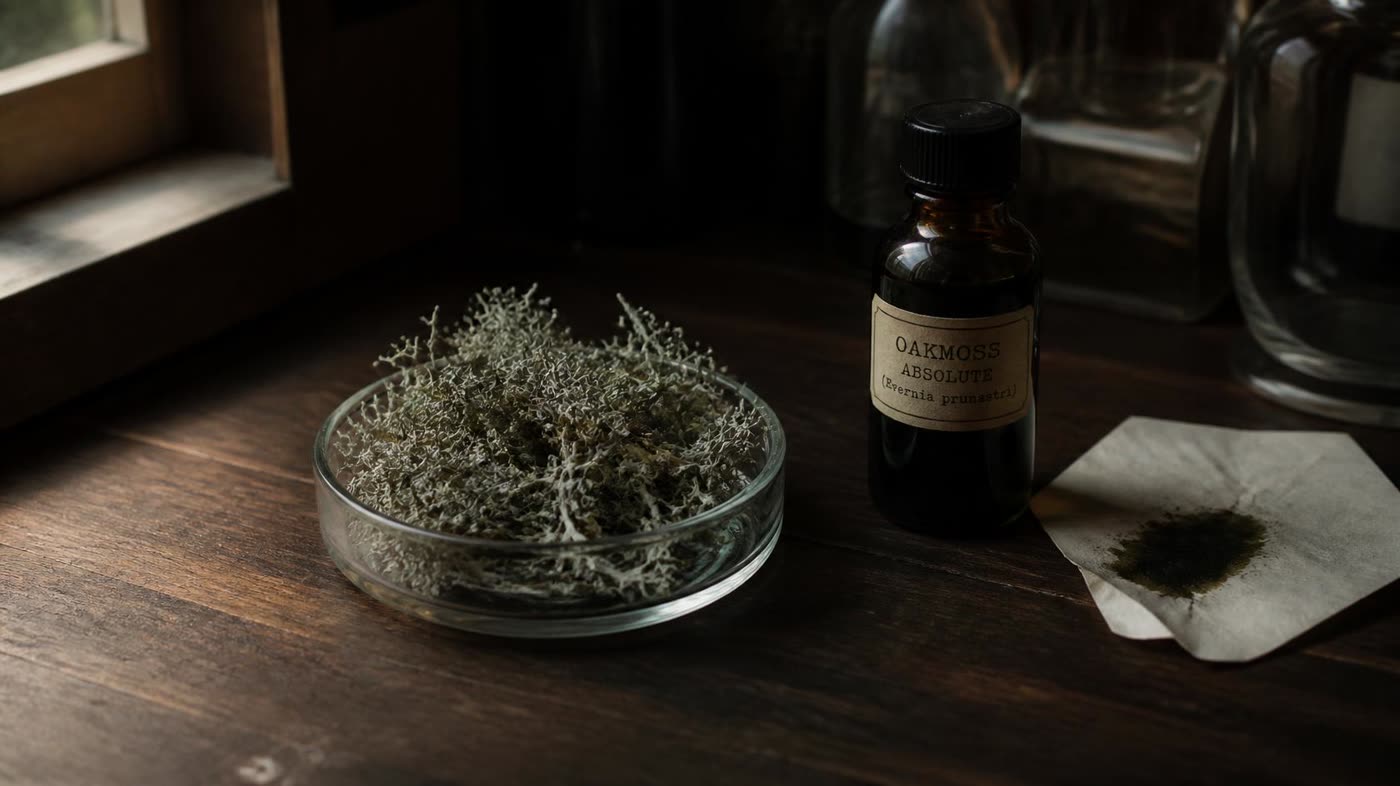
The limit on oakmoss is 0.1 per cent of the finished bottle. Not of the oil. Almost every mistake made with this material starts in that one word, because a bench sheet is written in per cent of the concentrate and the limit is not.
A chypre runs at 20 to 25 per cent concentrate. At 20 per cent, 0.1 per cent of the bottle is 0.5 per cent of your oil. At 25 per cent it is 0.4. That is the figure to write on the sheet. Meanwhile the library gives oakmoss a usual working dose of 0.05–1.5 per cent of the concentrate, and the top of that window is three times what category 4 will let you sell. Both numbers are right. A dose window says what the material does at that strength. The IFRA figure says what may go on skin. The second one wins.
Atranol is the whole reason
Oakmoss absolute is an extract of a lichen. Two of the things in it, atranol and chloroatranol, are potent contact sensitisers, and they are why the material is restricted at all. The rest of oakmoss was never the problem.
So the extract sold now is a low-atranol grade, with the pair taken out in processing. The library puts what is left at 40 parts per million of the material. The ceiling on atranol and chloroatranol together in a finished cosmetic is 2 parts per million. Divide one into the other and the low-atranol grade would only reach that ceiling at 5 per cent of the bottle, which is fifty times the limit on the extract itself. Stay inside 0.1 per cent and the atranol has stopped being yours to worry about. The processing already dealt with it. What still binds you is the restriction on the extract as a whole.
The three mossy options
| Oakmoss absolute low-atranol | Treemoss absolute | Evernyl | |
|---|---|---|---|
| IFRA, category 4 | 0.1 % of the bottle | 0.1 % of the bottle | No restriction |
| Working dose, of the oil | 0.05–1.5 % | 0.02–1 % | 0.05–2 % |
| Tenacity | 18 hours | 16 hours | 16 hours |
| Odour impact | 8 of 10 | 8 of 10 | 6 of 10 |
| Facets | Mossy, earthy, phenolic, inky | Mossy, pine, tar, green | Moss, dry, earthy, bark |
What it costs a chypre
The chypre skeleton in the studio is bergamot and galbanum over rose, jasmine and geranium, standing on oakmoss, patchouli, labdanum and vetiver. Oakmoss there is not a grace note. It is the floor. At four tenths of a per cent of the oil you will not get the floor the early chypres had, because they were not written to this figure.
That is worth saying plainly rather than designing around. A compliant chypre is a different perfume. The way to build one is to stop asking a single restricted material to hold up the whole base.
Four things to do instead
- Convert before you dose. On the bench, the column headed % of the bottle is the one every limit is read against. A dose that sits comfortably in the oil can be over the line in the bottle, and raising your concentration moves it there without you touching the dose.
- Buy the low-atranol grade. It is the only oakmoss in the library, and that is deliberate. Ask the supplier for the assay rather than trusting the label, because the residual figure varies.
- Split the backbone. Evernyl, methyl atrarate, carries no IFRA restriction and has a window up to 2 per cent of the concentrate. It is two points quieter, drier, and its facets are moss, dry, earthy and bark, with no phenolic. Let it carry the volume. Then spend your four tenths of a per cent of real oakmoss on the phenolic and inky part Evernyl does not have.
- Do not read treemoss as a second allowance. Treemoss absolute sits at the same 0.1 per cent, carries the same atranol, and the studio adds the two together. It is pinier and tarrier and worth having for that, not for headroom it does not give you.
And remember that the other three legs of that base are unrestricted. Patchouli goes to 12 per cent of the oil, vetiver Haiti to 10, labdanum absolute to 5. The moss is the thin part of a chypre base now. The earth underneath it does not have to be.
Build a 22 per cent chypre with Evernyl at 1.2 per cent of the oil and oakmoss low-atranol at 0.35. The oakmoss reads 0.077 per cent of the bottle, which is 77 per cent of its ceiling. Raise it to 0.45 and the studio warns you at 0.099, because it warns at 85 per cent of any limit rather than at the limit. Raise it to 0.5 and it fails. That warning band is the useful part: a ceiling is not a target, and batch variation and supplier assays both move underneath you.
Open the bench →