Coumarin: hay, tonka and the smell of a barbershop
Fourteen hours, a ceiling of 1.5 per cent, and already inside six of the naturals on your shelf. Most people use it twice over without noticing.
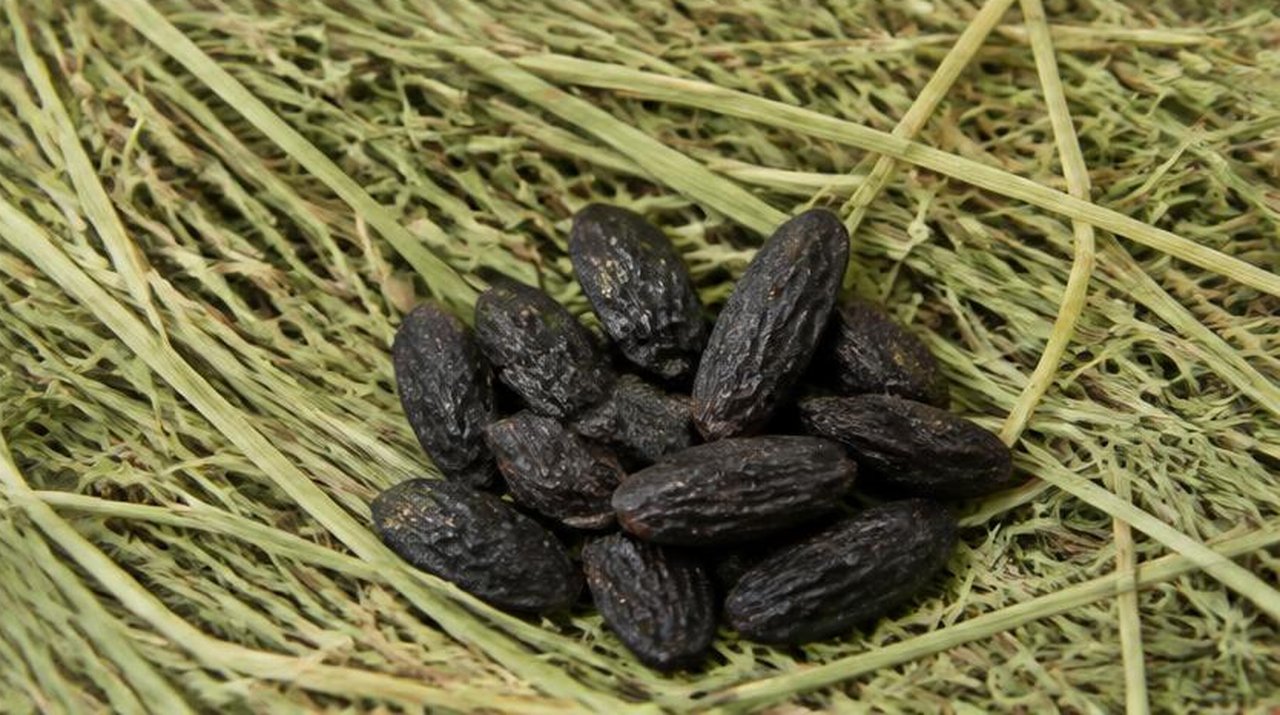
If tonka bean absolute, hay absolute or lavender absolute is on your shelf, you already own coumarin. It is inside them. In the Crafted Scent library tonka bean absolute carries coumarin at 35 per cent of its own weight, hay absolute at 10, lavender absolute at 2, and even plain lavender fine at two tenths of one per cent. Buy the crystals as well and you are dosing the same molecule twice, from two directions, against one safety ceiling.
On its own it smells of new-mown hay, almond and tonka bean, all of it sweet. It was first made in a laboratory in 1868, which puts it well ahead of almost everything else on the bench. Whether it was the first synthetic in a perfume depends on how you count, and that argument is not worth having. How much work it does is not in dispute.
What the numbers say
| Coumarin | What that means | |
|---|---|---|
| Family | Gourmand | Hay, almond, tonka, sweet |
| Zone | Base | It sits under a formula, not in the middle of it |
| Tenacity | 14 hours | Still there at the end of a working day |
| Odour impact | 7 of 10 | Strong, though not a trace material |
| Working dose | 0.1–4 % | Of the concentrate |
| IFRA, category 4 | 1.5 % | Of the finished product |
Those figures come from the Crafted Scent library, where every material sits on the same scale and can be compared rather than merely quoted. The last two rows are measured against different things. The dose is a percentage of the oil. The ceiling is a percentage of the bottle that reaches the skin.
What it does at each dose
The window runs from 0.1 to 4 per cent, a fortyfold spread, and the material is not the same thing at both ends.
- 0.1 to 0.3 per cent. You will not smell coumarin. You will smell everything else getting rounder. It takes the edge off a sharp lavender, fills the space between a herb and a wood, and adds a sweetness with no obvious source. This is the dose most formulas want and the one beginners skip, because nothing appears to happen.
- 0.5 to 1.5 per cent. The hay arrives and can be named. Under lavender, geranium and clary sage this is the barbershop, and it is the classical fougère the library sets out: coumarin with oakmoss, vetiver and musk in the base, at a concentration of 15 to 20 per cent.
- Above 2 per cent. It stops being structure and becomes the subject. Sweet, almond, close to edible, which is why the library files it under gourmand rather than aromatic. A fair thing to want, but it is no longer doing the quiet job.
Fourteen hours is what buys the quiet job. Lavender fine holds for two and a half, so the herb states the character and the coumarin carries it for another eleven. Tonka bean absolute holds longer still, at eighteen hours, but it arrives with vanilla and tobacco attached. The crystals give you the hay and the length on their own.
The ceiling, and the sum
Coumarin is capped at 1.5 per cent of the finished product in IFRA category 4. Convert that into oil and it turns out to be roomy. In a fougère at 20 per cent concentration, 1.5 per cent of the bottle is 7.5 per cent of your concentrate, nearly twice the top of the working window. Used alone, the cap almost never bites.
It bites when you add. The ceiling sits on the constituent, not on the bottle it arrived in, so the tonka counts. Take both materials to the top of their windows, 4 per cent coumarin and 3 per cent tonka bean absolute, and the tonka contributes 3 × 0.35, a further 1.05 per cent of the oil. The total is 5.05 per cent. At a 20 per cent concentration that is 1.01 per cent of the bottle and you are clear. At 30 per cent, an extrait, the same formula reads 1.515 per cent and you are over. It is a concentration problem before it is a dose problem, which is not how most people expect a limit to behave.
Those are working values for category 4 under the 51st Amendment. The studio scales the other seventeen categories rather than reading them from the standards, which the categories post explains. Check anything you intend to sell against the IFRA Standards Library.
Put coumarin on the bench at 2 per cent and read the safety panel. Then add tonka bean absolute at 2 per cent and read it again. The coumarin line has not moved and the constituent total has, because the checker counts the molecule rather than the jar it came out of.
Open the bench →Handling, and the near neighbour
It arrives as crystals rather than a liquid, so it goes into the concentrate first and may need warming to around 40 °C before the mixture runs clear. Vanillin is the same. A bottle still cloudy three days later is usually a solid that never dissolved, not a fault in the formula.
Dihydrocoumarin is the neighbour worth knowing, and it is not a substitute. Softer, creamier, a little coconut, and it holds for 6 hours against coumarin’s 14. Its own ceiling is 0.21 per cent of the finished product, seven times tighter. Use it when you want the coconut rather than the almond, and look that number up first.
Coumarin turns up everywhere because it rarely turns up as itself. It is a third of your tonka, a tenth of your hay, a trace in your lavender, and a line of its own in the base. Six naturals in the library carry it before you have opened a jar of crystals, which matters for the smell and matters again for the arithmetic.