The cheapest real bench: scales, pipettes, glass, alcohol
You can start properly for less than the cost of one designer bottle — as long as you spend it on the four things that matter and none of the things that do not.
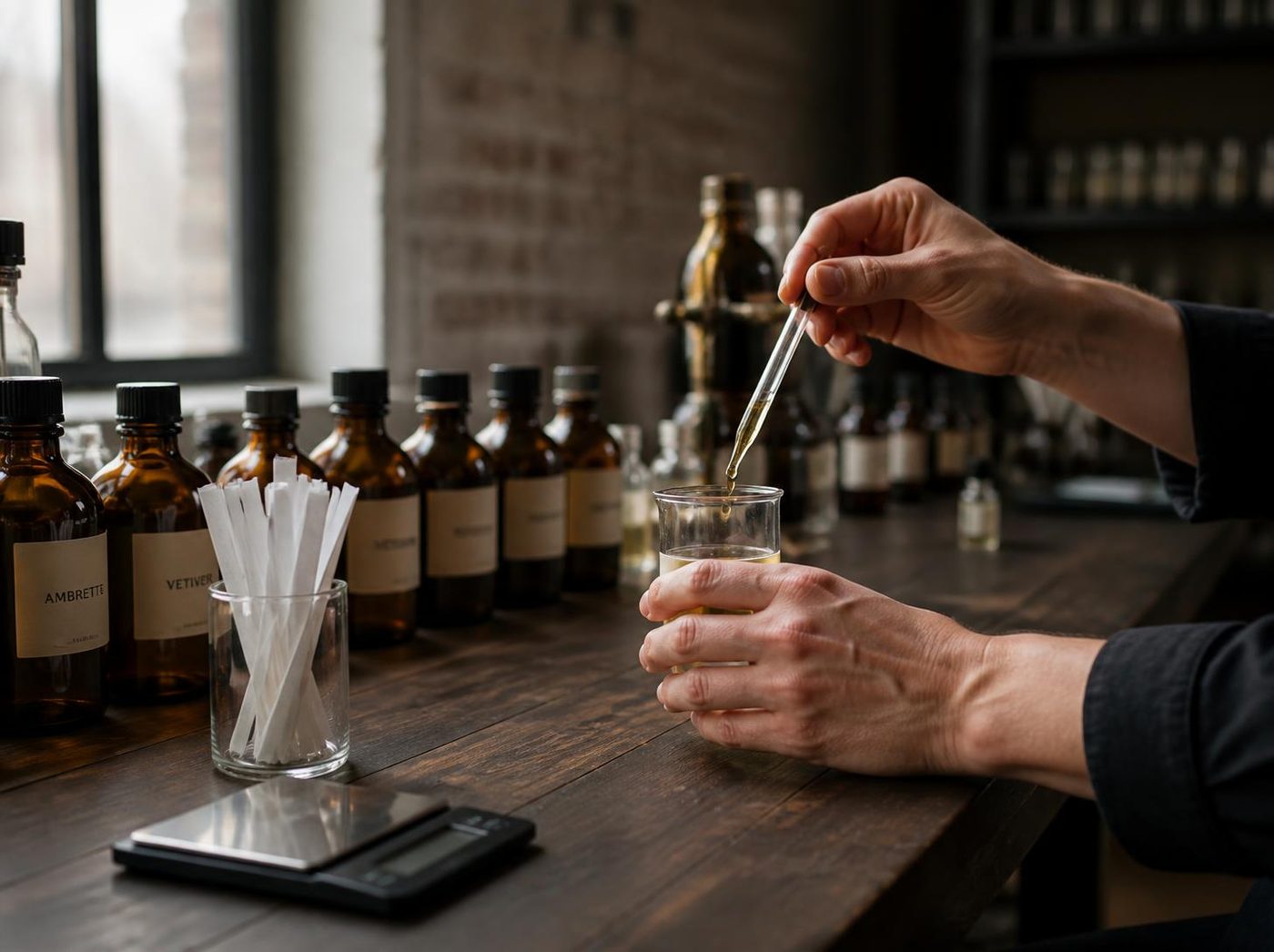
The equipment question stops more people than the craft does. It should not. A bench that can make a real, repeatable, safe perfume is four items long, and only one of them is worth thinking hard about.
1 · The scale — the only thing not to economise on
You want 0.001 g resolution and 50 to 100 g capacity. Not 0.01 g. The difference sounds like nothing and is the whole thing.
Here is why, in one line. Eugenol’s working dose runs 0.02 to 1 %. In a 10 g trial the bottom of that range is 0.002 g. A 0.01 g scale reads that as zero, and reads a fivefold overdose as 0.01. Your most powerful materials — the ones that decide what the perfume is — are exactly the ones it cannot see.
A second, coarser scale (0.01 g, 500 g or more) is genuinely useful later for batching and for weighing alcohol, and it is cheap. It is a second purchase, not a first.
2 · Glass
- Beakers, 10–50 ml, three or four. Glass does not react, does not hold smell, and washes properly.
- Amber bottles, 10 and 30 ml, more than you think. Every dilution you make needs one, and you will make more dilutions than materials.
- A stirring rod, or a clean glass pipette used as one.
Avoid plastic for anything that sits. Many aroma chemicals attack it, and the ones that do not will still pick up its smell.
3 · Pipettes
Disposable plastic transfer pipettes, in bulk, and one per material. Not one per session. Cross-contamination is the invisible ruin of a beginner’s bench: a single reused pipette puts a trace of the last material into everything afterwards, and you spend a fortnight wondering why every blend has the same odd note in it.
They cost almost nothing bought by the hundred. Treat them as consumable, like paper.
4 · Alcohol
Perfumer’s alcohol — ethanol denatured in a way meant for fragrance, or undenatured ethanol where you can get it. What you must not use: rubbing alcohol (isopropyl, which smells), vodka (too much water, and the water will cloud your perfume), or methylated spirit (which smells of the thing they put in it to stop you drinking it).
Availability is the one item on this list that depends entirely on where you are, and it is worth solving before you buy materials rather than after.
And the paper
Blotters — smelling strips. Buy proper ones; they are cheap and the alternative is judging materials on printer paper, which has its own smell. A hundred will last months. Buy a pencil at the same time and label every one of them before you dip it, not after.
What not to buy yet
| Tempting | Why not, yet |
|---|---|
| A 50-material starter kit | You will use eight of them and have forty-two bottles of things you cannot place. Buy ten materials you have chosen on purpose. |
| A laboratory-grade scale | 0.001 g is the threshold that matters. Past it you are buying capacity and a certificate, not accuracy you can use. |
| An ultrasonic bath | Warm water and patience dissolve everything it does. |
| Beautiful bottles | You are months from needing them, and their minimum order quantities are the subject of a different post. |
| A fume hood | An open window and not working with your face over a beaker covers home-scale quantities. |
The one thing that is not equipment
A notebook, used every single time, with the date at the top. Not a phone note. The formula is the product — the liquid is just the current copy of it — and a bench with perfect equipment and no record produces nothing you can build on. Every experienced perfumer has lost something good this way exactly once.
The Inventory in the Crafted Scent application is that notebook for what you own: what you paid, what is left, and what a batch of your formula actually costs at today’s prices. It also tells you which materials in a formula you do not have yet, which is the shopping list you want rather than the one a kit gives you.
Open the bench →What it comes to
Scale, glass, pipettes, blotters, alcohol. Prices move and differ everywhere, so check them where you are — but the shape of the spend is consistent: the scale is roughly half of it, the glass and plastic are almost nothing, and the alcohol depends on your local rules more than on any supplier. Materials are the real budget, and they are the part you should be spending on.
Which ten materials, and why those ten, is its own post.