Your first ten materials, and why these ten
Not the ten that smell best on a blotter. The ten that teach you the most, cost the least, and let you build something recognisable on the first evening.
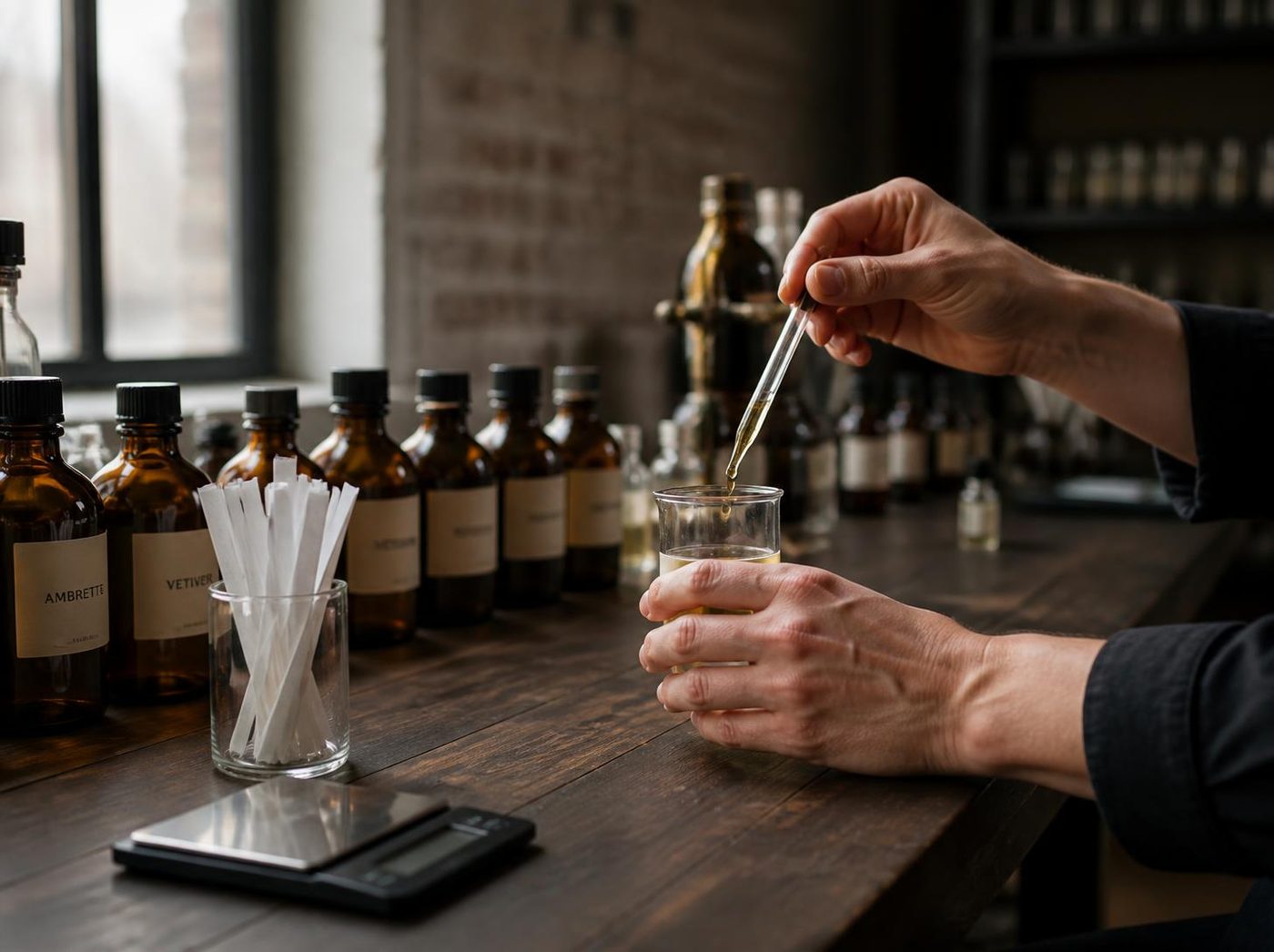
The first shopping list is where most beginners lose a hundred pounds and three months. The temptation is to buy the famous things — oud, orris, jasmine absolute — and to end up with a shelf of expensive materials that do not combine into anything, because nothing on it does the boring structural work.
What follows is a list chosen for a different purpose: to be cheap, widely stocked, useful in almost everything, and above all to teach. Nine of the ten appear in enormous numbers of commercial perfumes. Together they will make a cologne, a soft floral, an amber and a woody skin scent, which is most of perfumery's grammar.
The ten
| # | Material | What it teaches you |
|---|---|---|
| 1 | Bergamot FCF | What a top note is, and how fast one leaves. FCF means the furocoumarins are removed, so it is not photosensitising — buy this rather than expressed bergamot while you learn. |
| 2 | Sweet orange or lemon | Cheap, cheerful, and gone in an hour. Teaches volatility faster than any reading. |
| 3 | Lavender | The bridge between fresh and herbal, and half of a fougère. Also the classic beginner's lesson in "less than you think". |
| 4 | Geranium | A rose you can afford. Rosy, green, slightly minty; it teaches you what rose does structurally without a rose absolute's price. |
| 5 | Hedione | Almost odourless alone, transformative in a blend. It teaches the single hardest idea in perfumery: that a material can matter without being smelled. |
| 6 | Iso E Super | Volume and space. Make anything twice, with and without it, and you will understand what perfumers mean by "room". |
| 7 | Ambroxan | Warm, dry, skin-like, enormously tenacious. The shortest route to a base that lasts. |
| 8 | Vanillin | Sweetness, and a lesson in restraint — it is far stronger than expected and turns a perfume into a dessert at the smallest excess. |
| 9 | A musk | The floor everything else stands on. Take a macrocyclic if you can afford one; ethylene brassylate if not. |
| 10 | Cedarwood Virginia or vetiver | A real wood, to sit under the synthetics. Vetiver is the more interesting and the more difficult. |
Why not the famous ones
Jasmine absolute is glorious and will teach you almost nothing in month one, because you will not yet know what to do with it. Oud at hobby quantities is mostly a way to spend a great deal of money on something you cannot yet judge. Orris butter costs more per gram than most people's first entire shelf.
Buy those when you have a formula that needs them. That day arrives sooner than you think, and until it does they sit on the shelf oxidising.
The three things that are not materials
- A scale reading to 0.001 g. Not optional, and cheaper than you expect. A 0.01 g scale rounds your most powerful materials into nonsense.
- Perfumer's alcohol, or the closest you can legally get. This is the one genuinely awkward purchase and it differs enormously by country — work out what is available where you are before you order materials.
- Dipropylene glycol, for dilutions. You will work at 10% far more often than neat, and a litre lasts a very long time.
What to do with them in the first week
- Smell each one neat on a blotter, then again at fifteen minutes, an hour and the next morning. Write down what you find, in ordinary words.
- Dilute everything to 10%. Every one. It makes weighing forgiving and stops a single drop of vanillin ruining an afternoon.
- Build a cologne — bergamot, lemon, a touch of lavender, a little geranium, and something from the base to hold it down. Four materials is a perfume.
- Then build it again without the Iso E Super, and smell the two side by side. That comparison is worth a month of reading.
Put these ten on your shelf in the Crafted Scent application with what you paid, and every formula you build afterwards is costed automatically from your own prices — not a supplier's list. The library also carries all ten with their strengths, how long each lasts, and what they sit well with.
Open the application →