How to smell properly: blotters, spacing and fatigue
Your nose stops discriminating after about four materials. Almost everything else about smelling well is arranging your afternoon around that one fact.
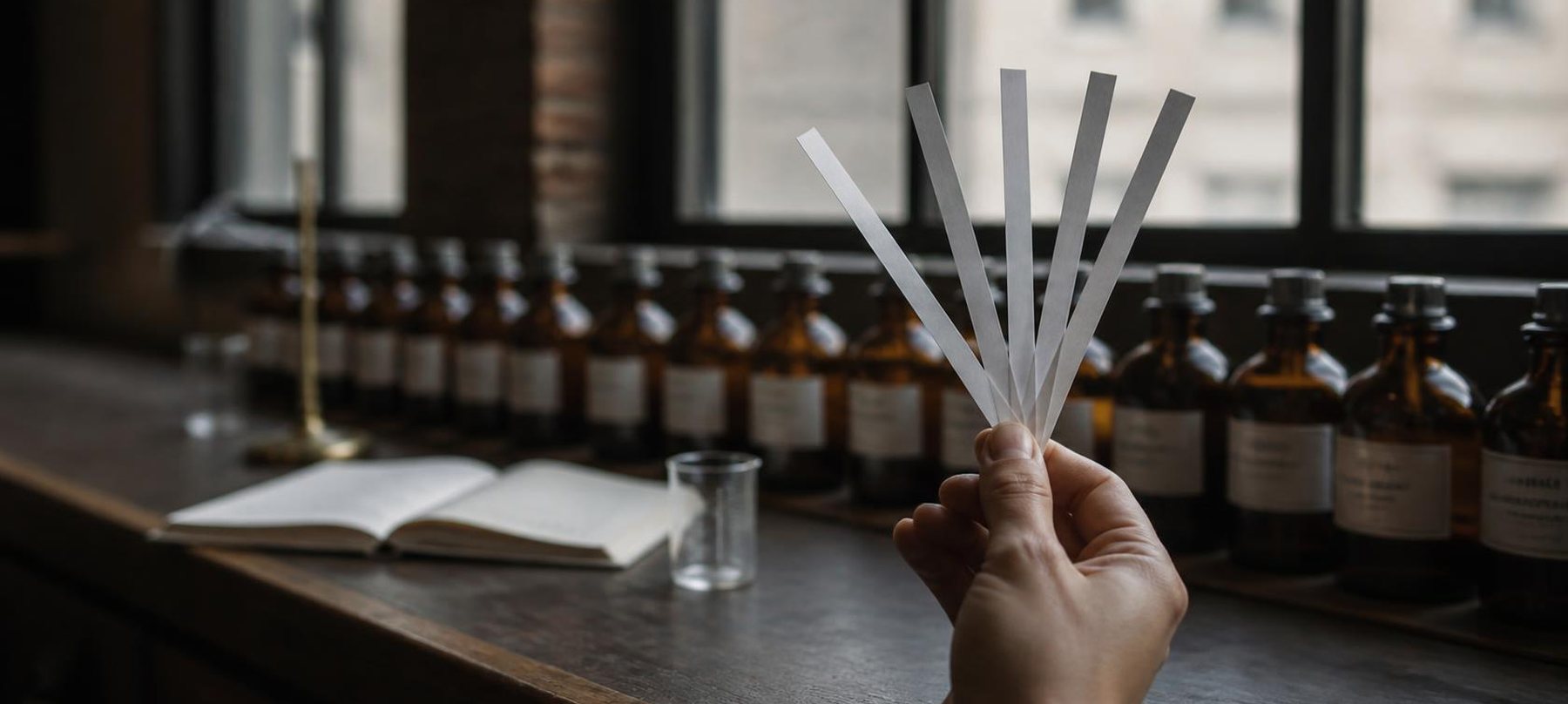
Nobody teaches this, which is odd, because it is the only skill in perfumery that every other skill depends on. You can learn formula arithmetic from a page. You cannot learn a material from a page, and most beginners spend their first year smelling badly without ever being told there is a way to do it well.
Paper first, always
Smell a material on a blotter before you ever put it on skin. Three reasons: skin changes materials, skin cannot be thrown away, and a blotter can be labelled, dated and returned to tomorrow morning.
Buy proper smelling strips. Printer paper has a smell, and it is not a neutral one.
Six rules that cover almost all of it
- Label before you dip. Not after. Pencil, on the wide end. Every perfumer has a fan of six unlabelled strips they can no longer tell apart, and every one of them made that fan exactly once.
- Dip shallow. Half a centimetre. A soaked blotter tells you about a puddle, not about a material, and it will dominate the room for the rest of the session.
- Never dip twice. A blotter is a consumable. Re-dipping tells you nothing new and contaminates the strip.
- Wave, do not press. Move the strip past your nose rather than holding it against it. Short sniffs, not long draws — a long inhale saturates the receptors faster and tells you no more.
- Keep them apart. Held together in a fan, four strips are one smell. Spread them, or smell them one at a time and put each one down.
- Dilute first. Most powerful aroma chemicals are illegible neat and honest at 10 %. See the post on dilutions.
Fatigue, and what actually helps
Olfactory receptors adapt fast. Somewhere around the third or fourth material in a row, your ability to tell one from another quietly degrades — and it degrades without announcing itself, which is the dangerous part. You do not feel your nose stop working. You just start making worse decisions with the same confidence.
What helps: stop. Leave the room, breathe air that is not full of what you have been smelling, and come back in fifteen or twenty minutes. Smelling your own forearm is a genuinely useful reset, because it is the one smell your brain treats as the baseline.
What does not help, as far as anyone has been able to show: coffee beans. The jar on the counter at the fragrance shop is a ritual, and the studies that have looked for an effect have not found one beyond what sniffing plain air does. It is not harmful. It is simply not the reset it is sold as.
Smell across time, not in a moment
A material is not a smell. It is a story with a beginning, a middle and an end, and the beginning is the least interesting part of it. Label a strip, then come back to it:
| When | What you are learning |
|---|---|
| Immediately | The top — the loudest and least durable part |
| 20 minutes | What it actually is, once the volatile edge has gone |
| 1 hour | Whether it is a top, a heart or a base at all |
| 4 hours | What it will contribute to a perfume you wear |
| Next morning | Whether it is a base material, and how good a one |
Bergamot is largely gone from a strip inside a couple of hours. Vetiver is still perfectly readable the next day. Reading those two words — "top", "base" — teaches you nothing. Watching it happen on two strips over one afternoon teaches you permanently.
Keep a smell diary
One line per material, written the first time you meet it and never rewritten: what it reminds you of, what you would use it for, and what you did not expect. Your own words, not the supplier’s. Nobody else’s vocabulary will help you recall a smell, and the value of the diary is not the description — it is that writing it forces you to decide what you actually think.
Read it back after a year. The materials whose entries you now disagree with are the ones you have learnt the most about.
Every material in the Crafted Scent library carries its facets, its odour impact and how long it lasts — so after you have smelled something and written your own line about it, you can check what the number says and see whether your nose and the data agree. The Blotter fan on the bench does the same for a whole formula: strip height is odour impact multiplied by dose, which is why 0.05 % of one material can be louder than 5 % of another.
Open the library →The habit underneath all of it
Smell one thing a day, on purpose, and write the line. Not a session, not a study afternoon — one material, sixty seconds, every day. A year of that is three hundred materials known properly, which is more than most people who describe themselves as perfumers can honestly claim, and it costs nothing but the deciding.