What a 50 ml bottle actually costs to make
Not the oil. The oil is the cheap part, and almost everyone gets this arithmetic wrong in the same direction.
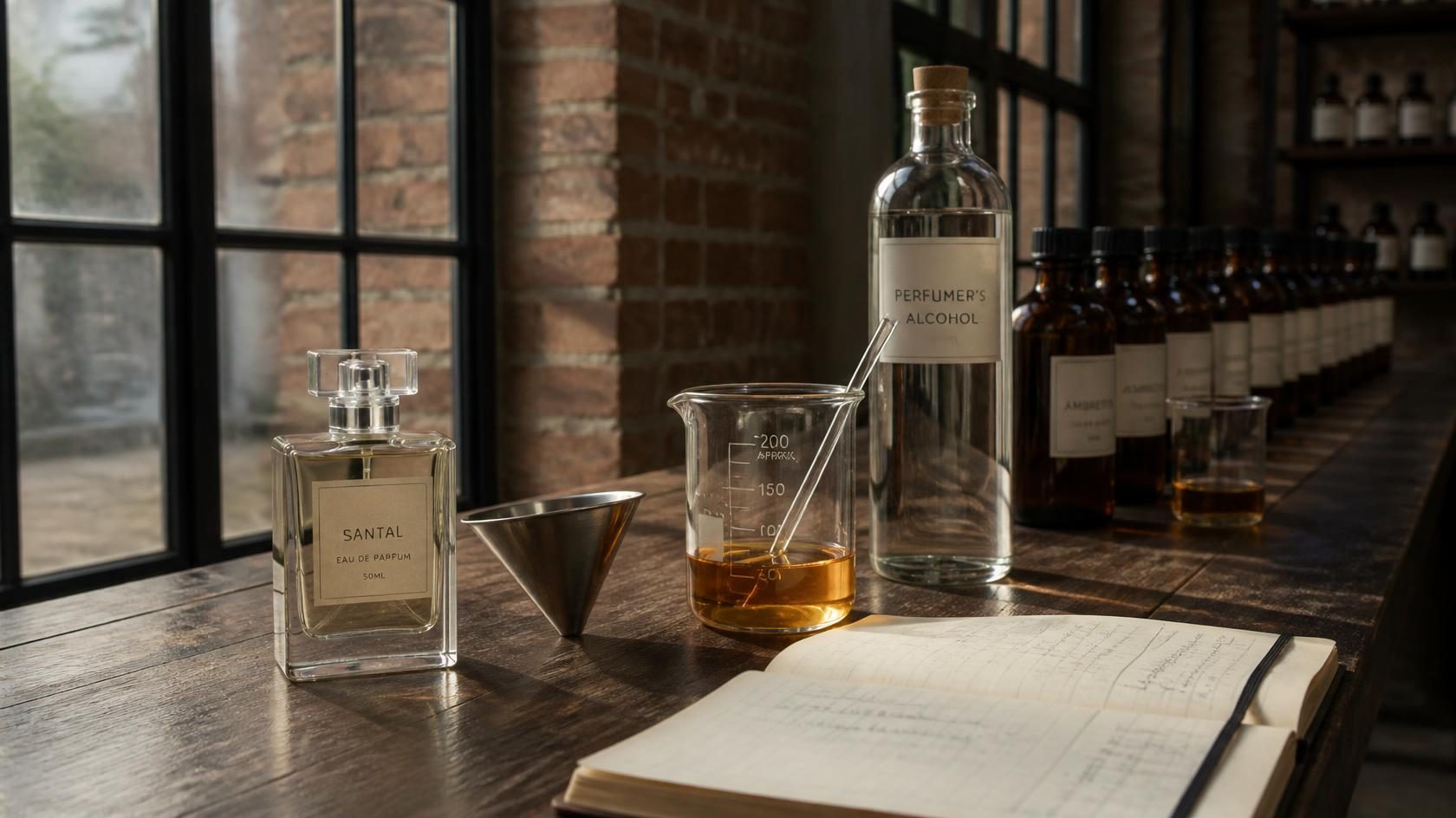
Ask a beginner what their perfume costs to make and they will tell you what the materials cost. Ask again in a year, after the first order of bottles, the first box of pumps that did not fit, and the first parcel that arrived broken, and you get a different answer.
Here is the whole arithmetic, in the order it actually hits you.
1 · The perfume itself
A 50 ml bottle at 20% concentration holds about 10 ml of aromatic oil — call it 9 to 10 grams depending on what is in it. So the question is what a gram of your formula costs.
That varies enormously. A formula built on citrus, Iso E Super and a cheap musk might average $0.30–0.80 a gram. One carrying jasmine absolute, orris and real sandalwood can be $5–20 a gram or worse.
| Formula | Per gram | Oil in a 50 ml bottle |
|---|---|---|
| Mostly synthetic, simple | $0.40 | about $4 |
| Mixed, some naturals | $1.50 | about $15 |
| Naturals-heavy | $6.00 | about $60 |
Notice how wide that is, and notice that even the middle case is not the largest number on this page.
2 · Everything that is not perfume
This is where the money goes, and where minimum order quantities bite.
- The bottle. At ten units you pay retail. At a thousand you pay a fraction of it. The same 50 ml flacon can be $6 or $1.20 depending only on how many you can afford to buy at once.
- The pump and collar. Frequently more fiddly than the bottle, and they must match its neck — the commonest expensive mistake a first-time brand makes.
- The cap. Cheap in plastic, surprisingly not in anything else.
- The box. Printed cartons have their own minimum orders, usually in the hundreds or thousands.
- The label. Small, and legally the most demanding part of the object — it has to carry what your market requires you to declare.
At hobby quantities, packaging commonly runs $8–15 a unit. At a few thousand units it can fall under $3. Nothing about your perfume changed.
3 · The alcohol, and the losses
The ethanol is genuinely cheap — well under a dollar for the 40 ml in a bottle — unless your country taxes it heavily, in which case it is not cheap at all and you must find out before you plan anything.
Then subtract what you never sell. Maceration, filtration and decanting lose a few per cent; a bottle gets contaminated, one arrives cracked, a batch is not right. Budget 5–10% shrinkage and you will be roughly correct.
4 · The bill
| Making 20 | Making 1,000 | |
|---|---|---|
| Oil (mixed formula) | $15 | $12 |
| Bottle, pump, cap | $9 | $2.60 |
| Box and label | $3.50 | $0.90 |
| Alcohol | $0.60 | $0.50 |
| Losses at 7% | $2 | $1.10 |
| Per bottle | about $30 | about $17 |
Those are illustrative numbers, not yours — but the shape is right, and the shape is the lesson. Volume roughly halves your unit cost, and almost all of the saving comes from packaging rather than perfume.
5 · What is still missing
None of the above is your cost of doing business. Still to come: the payment processor's cut (a few per cent plus a fixed fee per transaction, which hurts most on cheap orders), shipping and its packaging, returns and breakages, your website, samples given away, and any compliance or safety documentation your market requires.
And the largest missing line is your own time, which almost every small brand values at zero and should not.
What this means for the price on the box
This is why indie perfume is not cheap and why the usual multiples exist. If a bottle costs $30 to make in a batch of twenty, selling it at $60 does not leave you $30 — it leaves you a good deal less than that once fees, shipping, samples and the ones you gave away are counted. Brands typically price at several times cost for reasons that look greedy from outside and merely arithmetical from inside.
Work out your own number before you decide what to charge. Not an estimate — the actual number, from the actual prices you paid.
The Crafted Scent application costs a batch from your own Inventory — the moving average of what you have really paid for each material across every purchase, not a price from a website. Set a batch size and it tells you what the oil in a bottle costs you today.
Open the weigh-out →